
-
 By Julien Klaine
- 26/10/2026 à 12:38
- Guide
 By Julien Klaine
You open Analytics. The “ChatGPT” line is climbing, straight as an arrow, looking proud of itself. In a meeting, someone concludes that SEO is dying.
At HyperLinker, we put that line next to organic traffic. 486 Google Analytics properties, from January 2025 to September 2026. 176.5 million visits from Google. 2.13 million from an assistant.
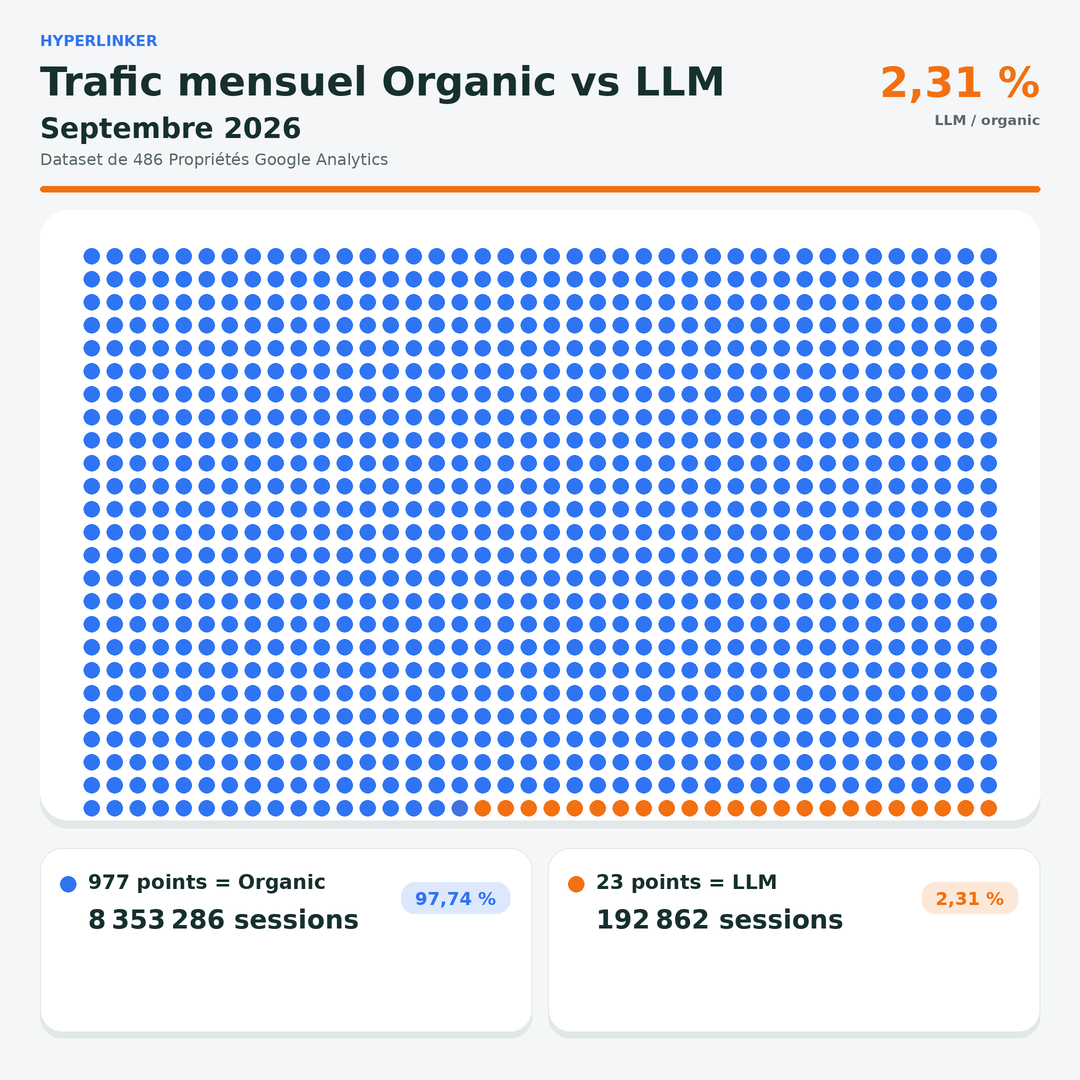
Then we mapped everything onto a grid of 1,000 dots. One orange dot = 0.1% of that month’s organic traffic. Blue is Google. Orange is ChatGPT, Gemini, Perplexity, Claude and the rest, combined.
Press play. Twenty-one seconds. One month per second.
January 2025: 3 dots. You have to look for them. 27,205 LLM visits, 10.6 million organic visits. 0.26%.
September 2026: 23 dots. 192,862 LLM visits, 8.35 million organic visits. 2.31%.
This AI traffic has an owner. In September 2026, ChatGPT accounted for 93% of LLM visits—more than 90%. Gemini and Perplexity split the rest. ChatGPT alone accounts for 2.14% of organic traffic.
The orange square has grown. It still fits in one corner of the image. The rest of the screen—the part that keeps websites going—is Google.
The line slept for a year, then woke up
The most interesting thing isn’t the 7× increase between the first and last months. January 2025 starts so low that any growth looks like a revolution.
Watch the middle of the video.
Spring 2025 takes off: 0.26%, then 0.47%, then 0.96%, then 1.47% in May. You start thinking that in eighteen months, assistants will have caught up with Google. That’s when everyone wrote the same think piece.
Then nothing. From June 2025 to April 2026, the ratio stays stuck between 0.94% and 1.27%. ChatGPT, which accounts for most of these visits, hovers around 70,000 to 90,000 sessions a month. The line that looks like it’s “exploding” on a standalone chart is a plateau next to Google.
May 2026 brings a second takeoff. 1.66%. August, 2.08%. September, 2.31%.
This time, it’s not a base effect. From September to September, LLM visits doubled (91,000, then 193,000). And since ChatGPT accounts for more than 90% of them by the end of the period, that’s mostly the line we’ve just watched.
Across all 21 months, the average comes to 1.21%. The month we’ve just seen has already surpassed it. Set your target based on last year, and you’ll aim too low.
“I’m getting 10%”
Could be. In September 2026, nearly one site in eight in the panel exceeded 10%. The median, though, is 2.3%, almost exactly the average.
Both figures can be true because the average is weighted by volume. A large site at 0.8% carries more weight than ten small sites at 10%. If you only look at your peers who post the most on LinkedIn, you’ll think the market has shifted. Add up the visits, and Google is still there.
And organic traffic hasn’t collapsed. September 2026 had 7.5% more visits than September 2025. Organic sales for e-commerce sites—which we’ll get to—are up 20% between January 2025 and September 2026. The channel is changing and moving with the seasons. It hasn’t surrendered.
Google often answers before the click
The blue dots are organic visits: people arriving from Google.
For a growing share of searches, Google no longer just shows a list of links. It writes an answer at the top of the page—Google Overviews—and cites a handful of sites. Some people read that answer and click nothing. Those who do click, whether from an Overview or a standard result, land in the same Analytics category: Organic Search.
The chart tells you how many visits Google sent you. It doesn’t tell you whether your site appears in those Overviews, what position you hold in the SERP, or whether an LLM mentions you.
This is where the HyperLinker platform offers a proper tracking tool. HyperLinker SEO rank tracking shows your SERP positions and your appearances in Google Overviews. AreYouMention Pro tracks your mentions in ChatGPT, Perplexity, Gemini, Claude and Mistral. HyperTools connects this to the rest of SEO: rankings, the impact of each link, audits and competitor analysis.
Do LLM visitors buy?
Yes. They convert better than organic visitors, in fact. And no, that doesn’t turn the whole picture upside down.
110 e-commerce properties. The same grid. This time, one orange dot = 0.1% of organic transactions.
January 2025: 2 dots. 352 transactions from an assistant, 202,900 from Google.
September 2026: 36 dots. 8,741 LLM transactions, 244,103 organic transactions. 3.58%.
The orange square for sales is bigger than the one for traffic. In September, across these stores, assistants account for 2.17% of organic sessions and 3.58% of transactions. They show up less often. They buy a little more often.
Now do the reverse calculation. In September 2026, Google drove 28 times more transactions than all assistants combined. Across the 21 months, 75 times more: 4.77 million versus 63,878. Last month, 96 out of every 100 sales from these two channels still came from organic traffic.
A ChatGPT visitor isn’t a Perplexity visitor
Across 21 months, the conversion rate for the 110 stores was 3.57% for organic and 4.22% for LLMs. 18% higher. Not a different world. In January 2025, LLM traffic actually converted slightly worse (2.26% versus 2.50%).
The gap opens up in 2026. By September, it’s clear: 6.18% for assistants, 3.75% for Google. One LLM session is then worth 1.65 organic sessions.
But first, we need to ask which assistant we mean.
- ChatGPT converts at 4.70%. It drives 84% of LLM transactions. It’s the channel that matters.
- Gemini converts at 2.79%. The second-largest source of visits, but worse than Google.
- Perplexity converts at 1.55%. People come to do research, not to pull out their credit cards.
- Claude posts an 8.94% conversion rate, but on barely 13,000 sessions. Strong intent, small pipeline.
Average all of that under the label “AI traffic” and you’re lumping a customer together with a reader. The first deserves a page, an offer and tracking. The second does too, but for different reasons. Neither replaces September’s 244,000 organic transactions.
What to take away
Most visits and sales still come from Google. In September 2026, assistants account for 23 visits per 1,000 organic visits, and 36 transactions per 1,000 organic transactions. SEO remains the primary lever.
Google Overviews are part of Google traffic. An answer appears at the top of the page, before the links. You need to know whether your site is cited there.
ChatGPT deserves to be tracked separately. It accounts for more than 90% of LLM traffic. Its visits doubled in a year. For e-commerce sites, transactions from assistants rose from 352 in January 2025 to 8,741 in September 2026, with a 6.18% conversion rate that month. It has become a real channel. That same month, Google drove 244,103 transactions.
Conversion rate alone isn’t enough to decide. A 6.18% conversion rate on that volume of LLM traffic brings in fewer sales than 3.75% on Google’s volume. Look at the number of transactions, not just the percentage.
The same offering, two scoreboards
That’s why the HyperLinker suite isn’t a GEO tool sitting beside an SEO tool. It’s the same work, viewed in two different ways.
The pages that rank are the ones assistants are willing to cite, provided they’re strong, well structured and connected to the rest of the site. HyperFactory produces them at scale, designed for Google and LLMs at the same time. HyperOptimizer aligns pages that are already live with search intent, internal linking and your data. A mention without a page behind it won’t last. A great page that nobody cites in their answer leaves the demand to a competitor.
Backlinks should no longer serve SEO alone. They should serve GEO too: placed on media outlets that LLMs draw from, to improve both Google rankings and citations. The HyperLinker catalog gives you access to more than 3,000 exclusive media outlets. Campaigns start from 3.5 million prompts already analyzed, and are published on sites that ChatGPT, Gemini, Claude, Perplexity and Le Chat actually explore—with more than 3,000 sites monitored daily. AreYouMention then measures whether your brand is cited.
HyperTools provides an SEO scoreboard: SERP positions, the impact of each link, audits and competitor analysis. AreYouMention Pro provides the LLM scoreboard, tracking the prompts that matter to your brand. Google Overviews appear in campaign tracking, alongside your rankings.
LLM visits will keep growing. Google visits will keep driving the numbers. HyperLinker helps you work on both, using the same pages.